

Destination Stewardship Report – Volume 6, Issue 2
This post is from the Destination Stewardship Report, a publication that provides practical information and insights useful to anyone whose work or interests involve improving destination stewardship in a post-pandemic world.

Tourists glide along the Mekong in long-tail boats, learning about the local way of life.
Thai Villagers Save Themselves with Tourism
Every year, the global Green Destinations Top 100 competition invites candidates to submit stories about sustainable management of tourism and its impacts. In this selection we learn how, when external forces began disrupting a Thai village’s fishing economy and way of life, community-based sustainable tourism helped save the day. Abstract by Mackenzie Morrow.
The Lesson: When You Can’t Fish, Show Off Your Culture
Top 100 submission and photos by DASTA.
Chiang Khan was in trouble. Climate change and upstream dam construction were disrupting the ecology of this small Thai fishing village along the Mekong River across from Laos, threatening local livelihoods and way of life. As fishing incomes dropped, many villagers left for better-paying jobs in the city.
In response, the community turned to sustainable tourism to protect their natural environment and cultural identity. In 2010 villagers formed a research group. With help from schools and universities, they created a conservation zone to protect fish habitats.
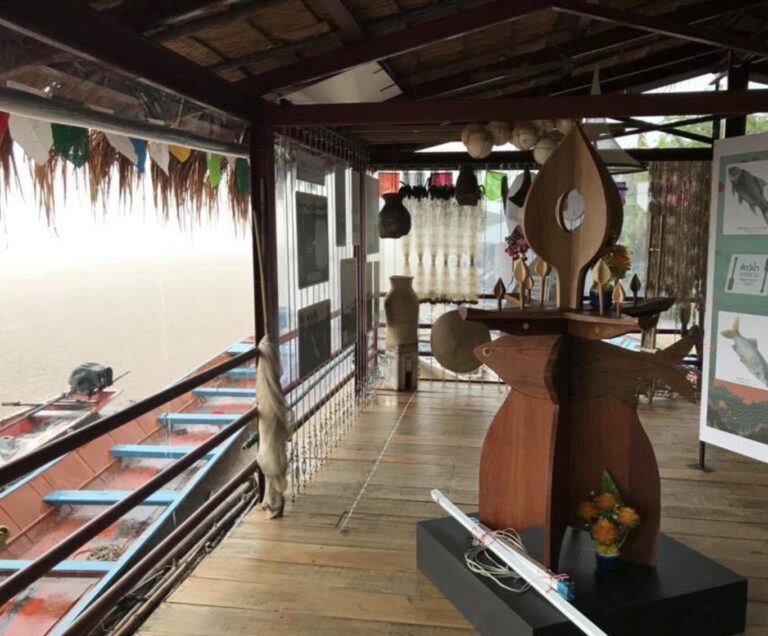
The Chiang Khan Learning Center, made from driftwood.
Support from Thailand’s Designated Areas for Sustainable Tourism Administration (DASTA), helped them build a Learning Center from driftwood to preserve fishing knowledge. In 2016 it became a cultural tourism site where locals taught skills and led ecotourism activities such as riverbank nature walks, observation boat tours, sunrise fishing trips, and riverside cooking workshops.
Adapting to disruptively fluctuating river levels has required four strategies – eco-tourism activities for off-season income and public education about the fragility of the Mekong River; local data collection tracking waste, riverbank erosion, and ecological risks to guide future decisions; school education programs to inspire local youth through camps and storytelling; and community-led advocacy to modify river basin policies, especially upstream dams.
For Chiang Khan, “tourism became a bridge of hope,” providing income, reviving pride, and helping fishermen save a way of life once at risk of disappearing.