

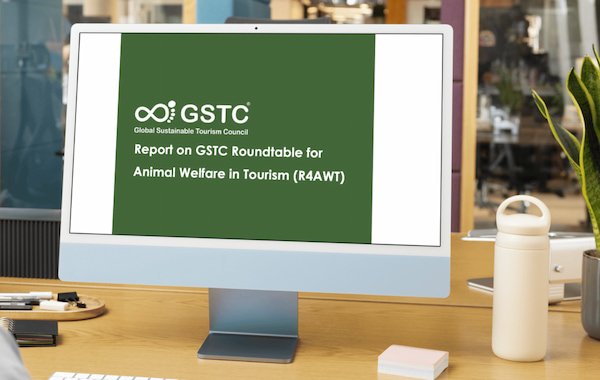
The Global Sustainable Tourism Council (GSTC) has released the first report from the R4AWT – Roundtable for Animal Welfare in Tourism, an initiative established to support dialogue and collaboration on animal welfare practices within the tourism sector, aligned with the GSTC Standards.
–
The R4AWT initiative was created as a multi-stakeholder platform bringing together representatives from conservation organizations, animal welfare experts, tourism businesses, industry associations, and assurance professionals. The roundtable provides a space to exchange perspectives and share experiences related to animal welfare challenges and responsibilities in tourism activities.
The roundtable was convened to explore how animal welfare considerations can be more consistently addressed within tourism operations, with a focus on improving practices, strengthening guidance, and supporting credible, transparent approaches that align with the GSTC Standards.
The report presents key observations and shared perspectives from the roundtable discussions, including:
- A shared view that animal welfare in tourism must be assessed from the animal’s perspective, using science-based frameworks such as the Five Domains of Animal Welfare.
- Clear agreement that legal compliance alone is not sufficient, and that animal welfare criteria must address ethical/responsible and welfare outcomes, not only regulatory requirements.
- Identification of tourism practices that pose the greatest welfare risks, including close contact with wild animals, forced performances, feeding, and abusive or inappropriate training methods.
- Strong emphasis on the need for clearer, more consistent wording and definitions to reduce ambiguity and support fair, enforceable auditing across regions.
- Recognition that species-specific and context-sensitive approaches are essential, while maintaining non-negotiable minimum welfare expectations globally.
- Agreement that tour operators, hotels, and their suppliers play a decisive role in shaping animal welfare outcomes through experience design, supplier selection, and guest guidance.
- A shared understanding that auditor competence, guidance, and training are critical to ensuring consistent and credible certification decisions.
- Consensus that education, transparency, and continuous improvement are more effective than purely punitive approaches in improving animal welfare in tourism.
Also, during the discussions, members proposed developing a formal glossary to clarify key terms related to animal welfare. In response to this recommendation, GSTC is pleased to publish the first version of the GSTC Animal Welfare Glossary, aimed at supporting consistent understanding and application of animal welfare principles across the tourism sector.
“The Roundtable provides a dedicated forum for stakeholders to share experiences and refine approaches to animal welfare in tourism. Our first year of discussions highlighted key challenges and identified actionable next steps for stakeholders. GSTC is committed to continuing this vital dialogue—for the benefit of both animals and humans—and is developing a specialized animal welfare training course in response. This inaugural report brings together diverse perspectives on a sensitive, yet crucial, topic for our sector,” said Dr. Mihee Kang, Chief Assurance Officer at GSTC.
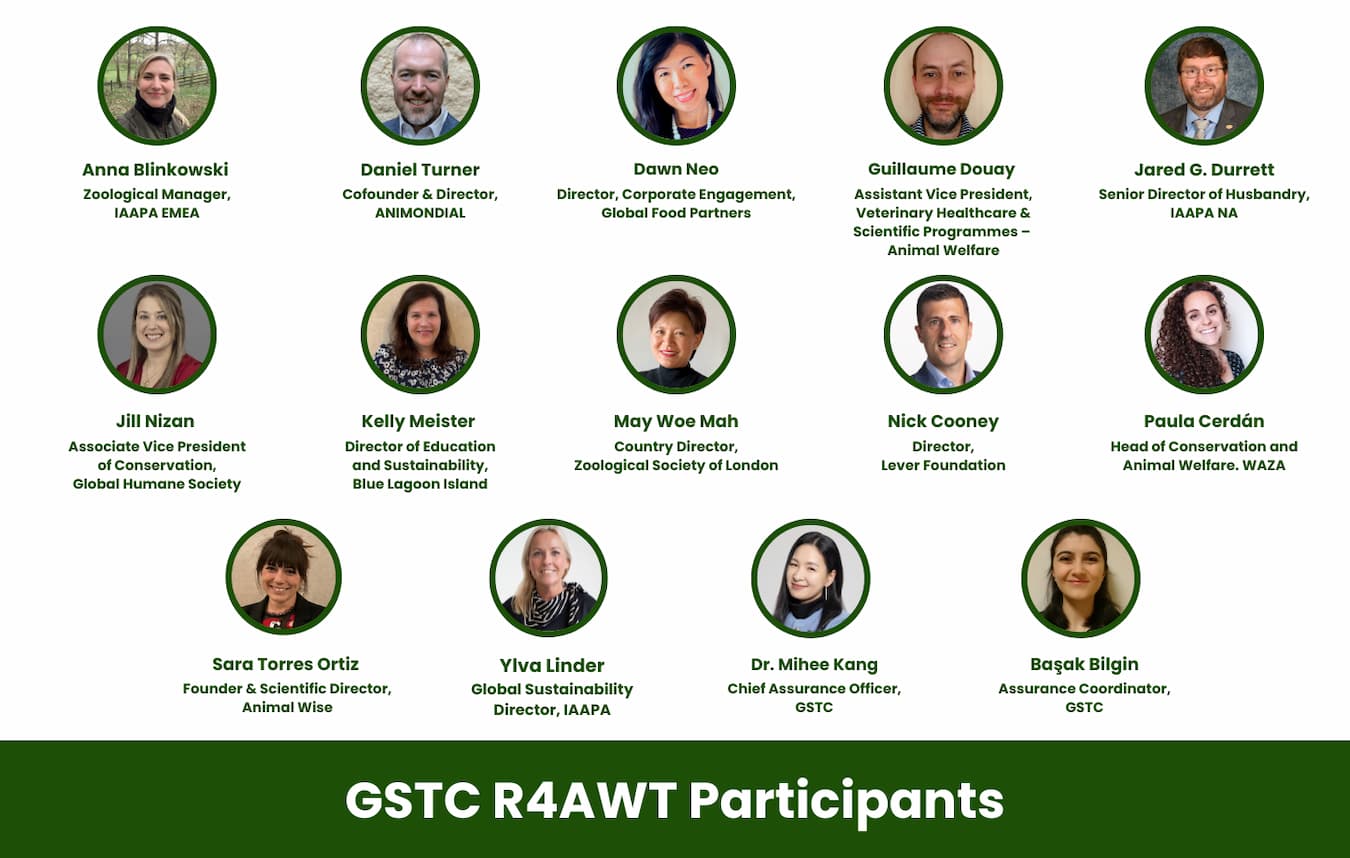
This Roundtable Report reflects the discussions and contributions of participants who took part in the roundtable, including:
- Anna Blinkowski (IAAPA EMEA, Zoological Manager)
- Ariana Hernández (Animal Wise, Founder & Director)
- Daniel Turner (ANIMONDIAL, Cofounder & Director)
- Dawn Neo (Global Food Partners, Director, Corporate Engagement)
- Guillaume Douay (Assistant Vice President, Veterinary Healthcare & Scientific Programmes – Animal Welfare)
- Jared G. Durrett (IAAPA NA, Senior Director of Husbandry)
- Jill Nizan (Global Humane Society, Associate Vice President of Conservation)
- Kelly Meister (Blue Lagoon Island, Director of Education and Sustainability)
- May Woe Mah (Zoological Society of London, Country Director)
- Nick Cooney (Lever Foundation, Director)
- Paula Cerdán (WAZA, Head of Conservation and Animal Welfare)
- Rodolfo Raigoza Figueras (IAAPA LAC, Corporate Conservation Director)
- Sara Torres Ortiz (Animal Wise, Founder & Scientific Director)
- Uzair Jaffer (Sustainability Leader)
- Ylva Linder (IAAPA, Global Sustainability Director)
- Dr. Mihee Kang (GSTC, Chief Assurance Officer)
- Başak Bilgin (GSTC, Assurance Coordinator)
This report represents an initial step in an ongoing process of dialogue and collaboration. Future R4AWT Roundtables sessions will continue to gather input and contribute to the development of guidance and approaches that support improved animal welfare outcomes across the tourism sector.
Participant Statements
Jill Nizan (Global Humane Society)
“Global Humane Society is honored to participate in this Roundtable for Animal Welfare in Tourism and commends the Global Sustainable Tourism Council for taking this important step to ensure animal welfare remains a central pillar of responsible tourism,” said Jill Nizan, Associate Vice President of Conservation at Global Humane Society. “We look forward to continued collaboration with like-minded organizations and to contributing our science-based animal welfare expertise across the tourism sector.”
Daniel Turner (Animondial)
“ANIMONDIAL is delighted to have contributed to the development of the GSTC Animal Welfare Standards. This collaborative effort, bringing together diverse stakeholders and perspectives, has produced a practical, science-based framework that recognises animal welfare as a core responsibility in tourism while reinforcing existing industry guidelines. By providing consistent global guidance, the standards equip everyone who keeps, manages, or interacts with animals to act responsibly. I warmly encourage tour operators, destination management organisations, hotels, and attractions to adopt and apply these standards in practice.”
Paula Cerdán (WAZA)
“Advancing animal welfare in tourism requires collective action. The R4AWT brought together animal welfare experts from the wider tourism sector and the global zoo and aquarium community to share knowledge, map existing guidance, and take shared responsibility for ethical interactions with, and care for, wildlife – both in the wild and under human care.”
Sara Torrez Ortiz (Animal Wise)
“I am deeply grateful to contribute to this Roundtable, which provided a rare opportunity to integrate robust, science-based animal welfare standards into sustainability frameworks. GSTC’s initiative in hosting this dialogue clearly demonstrates its pioneering leadership in advancing truly responsible and sustainable tourism.”
Guillaume Douay (Mandai Wildlife Group)
“R4AWT was an engaging effort that united animal welfare professionals from many horizons. The collegial approach made the entire process smooth and highly stimulating. It was both important and valuable to bring together the different actors involved in animal welfare in tourism.”